

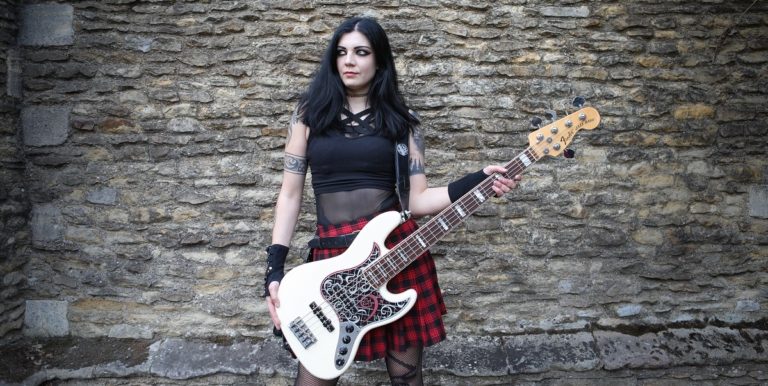

Some musicians are a decent fit with their chosen instruments and the play them well. Some though, just a handful, resonate in perfect harmony with them. They make their instrument sing. One such person is bass ace Becky Baldwin who currently plies her trade with grunge delinquents Hands Off Gretel and the hard rockin’ Fury. Keeping everything as untechnical as possible Gary Trueman chatted to Becky about why she chose the bass guitar, why a fifth string is now an option and who it was that made her want a Rickenbacker bass in particular.
What made you first want to pick up and play a bass guitar?
“It wasn’t that I wanted to play bass guitar specifically it was that I did want to play music and bass was a rock instrument. I played keyboards and piano first a little bit and I was really bad at it. When I started getting into rock music I wanted to play that kind of thing. Some of my friends had started to play guitar. My sister started to play guitar as well. I kind of wanted to join in but I didn’t want to copy them so I thought what else could I do? Someone suggested bass saying it was a bit different but still cool and I thought yes why not, let’s go for it. I got my first bass and I just fell in love with it. I thought it was so cool. And once I understood what the bass was, looking at a band, I felt that the bass player is the cool one. They always stand out. They’re always a bit different. They’re not like the vocalist or the lead guitarist, They have a quiet coolness about them and I feel like I connected with that.”
So before we look at the bass guitar in a little bit more depth what ones do you own and play right now?
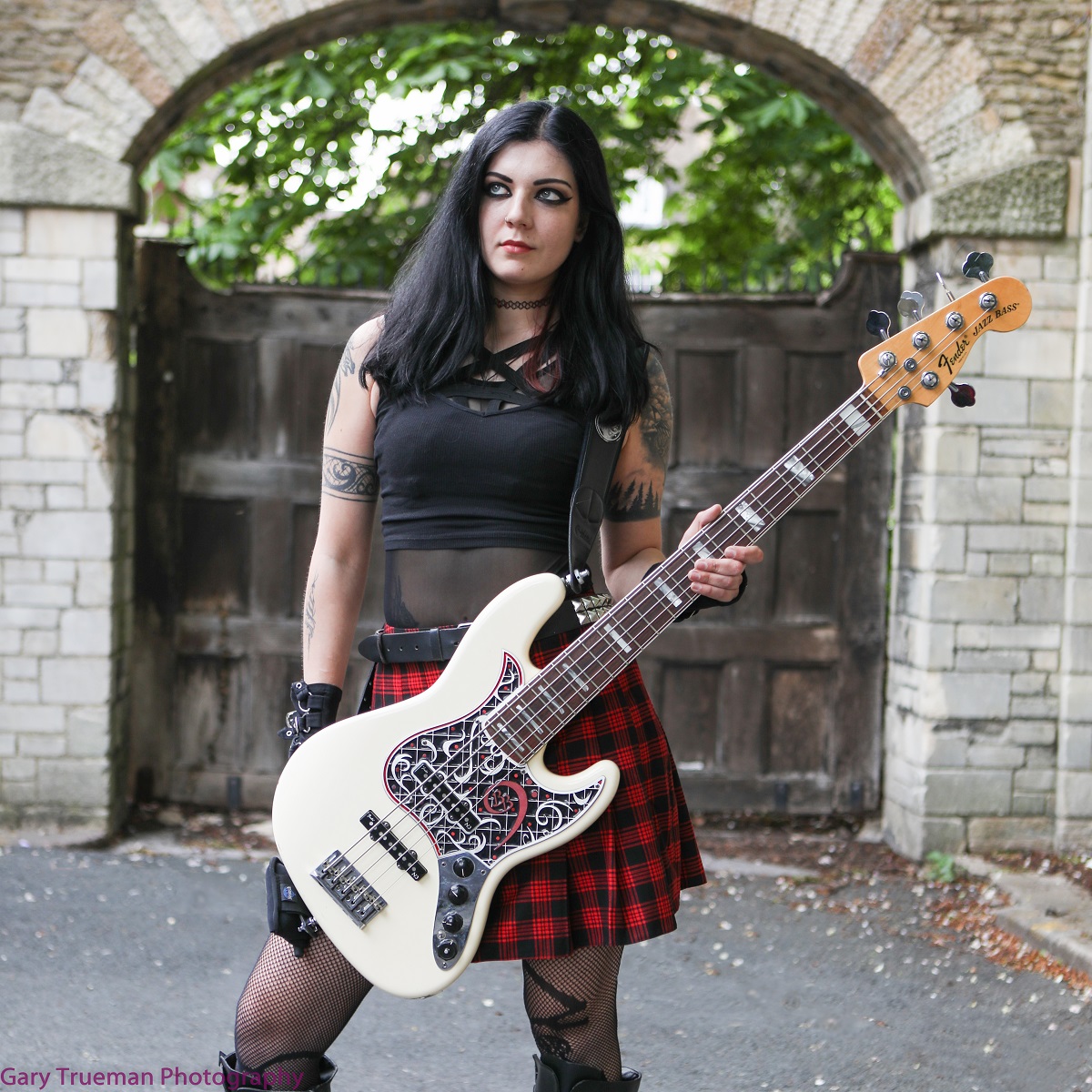
“There are three main ones that I use. For Hands Off Gretel I mainly use my Rickenbacker 4001 which is from 1977 so it’s a bit of a vintage one. It’s been customised. I also have a five string bass which is a Fender Jazz De-Luxe. I use that for Fury quite a lot. The other one is another Rickenbacker which is a 4003 and was made in I think 2002 so it’s a newer model. “
Lemmy was a Rickenbacker player wasn’t he?
“Yes he was. It’s one of the reasons why I always wanted a Rickenbacker. He was one of the first bass players I saw. One of the first concerts I saw was Motorhead and I loved the bass he was playing. I love the 70s and 80s aesthetic and those are the eras I love. So I always wanted a Rickenbacker and now I have two and I’m very happy.”
Let’s talk a little bit about the instrument itself and the stuff that surrounds it. You’ve said what bass guitars you own and the first thing we ought to have a little bit of insight into is what is the difference between the more traditional four string bass and the relatively new five string other than the obvious. Why the extra string?
“The first bass was the double bass which was always a four string instrument. They tried to make it smaller and make it electric and more portable. It became the standard electric bass that you have now. I think, and I’m not sure if I’m completely correct with this but it was in the 70s and 80s when there was a lot of synth bass going on. More bass lines were being played on a keyboard. They could go lower than the lower than the low E string that a bass would do. So then there was a demand for the bass guitar to mirror what the synth was doing. So it was necessary to go lower and rather than just de-tuning that was when five strings started to happen. So a five string bass is the same as a four string but with one extra string that is lower. It is a bit more when you’re used to a four string, to make the change. It takes a little bit of time to get used to it but it is worth it to have those extra notes if you need them.”
With strings it’s fair to say you won’t use them up as fast as you would with a regular guitar because they’re thicker. What strings do you use and what differences are there within the bass guitar for customising your sound through a change of strings?
“I use D Addario Nyxl strings. My size is 45 to 105 gauge (string thickness). That’s a medium. You can go heavier if you’re tuning low, it’s better to take heavier strings. So on the black Rickenbacker 4003 I tune low to D standard so I have thicker strings on that. But you might want lighter strings if you have a lighter touch. I think for tone then thicker is better but there will be some things that you will struggle to pull off.”
One thing that bass guitars and regular guitars have in common is that people will change the pick ups (which converts string vibrations into electricity) as a way of customising a guitar. The distance between the pick up and string is a critical part of a guitar too. So have you changed any of the pick ups on your bass guitars and if so what have you gone for and why was that change made?
“So both of my Rickenbackers have new bridge pick ups which the purists absolutely despise haha. There’s a lot of Rickenbacker fans and they think that that is a Rickenbacker sound and you can’t change the pick ups. But I’ve changed the bridge pick ups on both of mine to Seymour Duncan, which I believe Lemmy used in his. So obviously I was going to do it. They have a more aggressive metal sound, a heavier sound. You do need to change them really. It’s a kind of legacy vintage instrument. So as a company they don’t need to change from where they were when they first started. They have modernised a bit but if there’s a particular sound you’re going for you’ve just got to find that through whatever pick ups you need. And for me that was Seymour Duncans.”
So in reality as technology has progressed people are changing their pick ups because they have more in them or are more capable of creating a sound that’s required?
“I think so. It’s not necessarily that they’re better but the technology is different and the sounds people want to achieve is different. The ones I have have a much higher output which works for metal. The other ones are a bit quiet and dull which some people like but not for me and the kind of music I play.”
People will see guitarists and bass guitarists using pedals and pedal boards. What pedals do you have and do bass pedal and regular guitar pedals differ at all?
“Really you don’t need anything different from a guitarist. All the pedals will work they’ll just sound slightly different. You may want certain pedals that are designed for bass but they all work.If you want a subby sound you may want one for bass. One of the pedals I used for a long time, the MXR Overdrive, that was a guitar pedal. It was given to me and it had the most aggressive tone, it was quite tinny really but I loved it. But now I use a Darkglass Photon pedal. That has loads of different pre-sets. That’s the only pedal I use now.”
What about heads, cabs and combos too. So heads (amplifier) and cabs (speaker cabinet) come separately whereas with a combo they’re all in one unit. If you ever watch a band load in they’ll put the head on top of the cabs which often a venue will supply. So what do you use and do you get specific heads and cabs for bass guitar?
“You’ll need a specific speaker for bass because of the vibrations and frequencies, the way the speaker has to move the air. If you try to run a bass through a guitar amp you can blow the speakers. I use a Darkglass 2 x 12 ( two 12” speaker cones) cabinet and their Alpha Omega head. Both are great. Sometimes I will use the venue cab, if there’s a lot of stairs or for others reasons.”
So when a venue or band talks about a backline they’re talking about the cabs and your breakable which for a bass guitarist or guitarist is the head?
“Yes. I think that’s the main benefit of having the cab and head separate. You can leave some gear on stage and just move what’s breakable. So two bass guitarists playing a show can just stack their heads on top of each other (and use a single cab).”
Moving on and talking a little bit about you now and your relationship with playing bass guitar. Who were the people that you saw that you fell in love with their playing regarding bass? Who inspired you as a young musician?
“For the start it was Lemmy, he was a big influence. It’s still the same bands and people that are influencing me now. People like Cliff Burton of Metallica. When I first started learning The Darkness had just released Permission To Land and I thought Frankie with his Thunderbird bass looked really cool. In terms of influencing my playing, definitely Lemmy, Steve Harris of Iron Maiden, and Cliff.”
What’s the best thing about playing bass in a band?
“I think it’s cool to be the glue between the drummer and the guitarist, even if people may overlook your importance. If you throw some interesting tones in there you can really change the whole thing. I like listening to the drums and listening to the guitar and thinking OK what will work with both of them? Whereas I feel like drums are very isolated and guitar is its own beast but being the rhythm and glue between the two is a quite special place. With bass it is easy to get going. There’s no easy instrument, everything is as hard as you want to go with it. You just keep playing, keep putting in those hours and get better. But bass is a very accessible instrument if you just want to learn a few things and start gigging. You can absolutely do that.”
And conversely what are the worst things about playing bass?
“People not knowing what you do and thinking of you as unimportant. People do overlook you a little bit. I think they kind of think you’re not as smart, that you’ve got the dumbed down version of guitar.”
If someone asked you why they should play bass guitar what would you say to them?
“Do it because bass players are never without work. When I went to music university there was twenty guitarists for very bass player, or something like that. If you were a bass player there was always a band you could join and always a gig you could have. Some guitarists had to play bass because there weren’t enough to go around. You can always tell when a bass player is actually a guitarist, they look like they’ve been demoted. But I don’t see it like that, I really like being the bass player.”
Interview and photos by Gary Trueman