

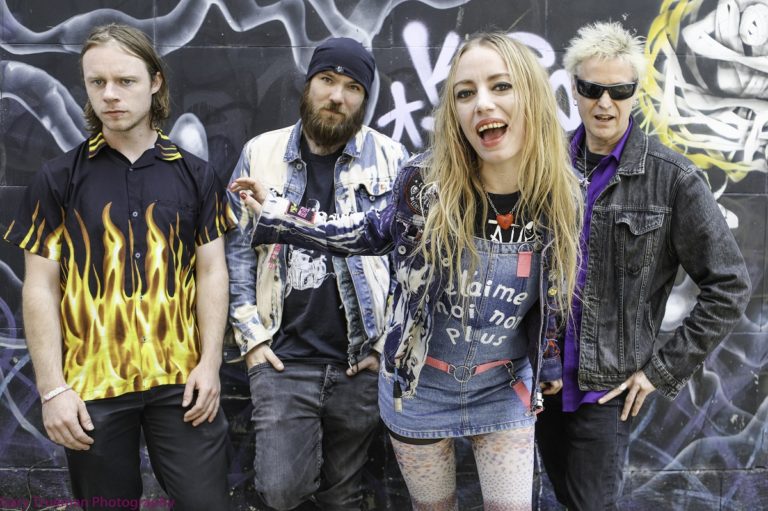

Stalwarts of the underground music scene Healthy Junkies have built a formidable reputation for having consistently high standards, for their consummate professionalism and also for having a laid back friendliness. They work their socks off too. Gary Trueman chatted to Nina, Phil, Dave and David about the band community and their own event Punk N Roll Rendezvous.
You’re playing a lot of gigs at the moment. Is it important to keep that momentum going? And playing all the time gives you a level of ‘match fitness’ too doesn’t it?
“Yes, there’s always another gig around the corner and we’re tight as a band too by doing that. And what else are we going to do? It’s definitely good for a band to keep playing and also we bond together more as a unit. And we pick up more people along the way too. Plus you save a lot of money on studio time.”
You’ll meet lots of bands on the road but do you also find you meet some who you get booked with repeatedly and they then become friends? Are there any in particular?
“Definitely, there’s bands like Yur mum, Pollypikpocketz, A Void, we all know each other really well. It’s a bit of a scene where we all end up getting put on the same bills quite often. It’s like a family. Like Rebellion is like a family, it’s a community, we all know each other and that’s what makes it special.”
You’re also involved with a thing called Punk N Roll Rendezvous. Would you like to tell us a bit about what that is, and where and when it happens?
“Punk N Roll Rendezvous was born in The Unicorn in Camden which doesn’t exist any more. It’s been going since 2011. It used to be monthly but now we’re doing it as a festival on September 1st, 2nd and 3rd at The Water Rats, Dublin Castle and The Post Bar and we are also doing some Saturdays at The Water Rats and The Post bar as well. It started as the monthly night and after a few years we started putting on the annual festival. The festival is in its eighth year. We started it to help promote women musicians. Ten or eleven years ago not a lot of women were on bills. Our friend Steve Isles would always provide bands from out of town. So we’d have out of town bands mixed with London bands. And it’s built into a little scene in London because at first no one really knew each other and it brought people together. So we would play with bands from Birmingham, Manchester and Scotland and then they would invite us to play in their towns.”
That’s interesting because they had a thing a while back where they had a band exchange and acts would guest in each other’s home towns.
“That still happens quite a lot. We get bands that will contact us that have heard about Punk N Roll Rendezvous, they contact us for a gig and we do an exchange, even in Europe. We’re doing that very thing in October, we’re going to Amsterdam to play a gig on an exchange, and Paris as well. We like to cross over with bands from different genres, we’re not purists, we don’t stick to any genre.”
There’s a point to pick up from that. Punk N Roll was initially started to help promote women in music. That has moved on a long way in the last decade or so since you started it up. It’s still not perfect by any means but also you get places like Rebellion, and the punk scene generally are better at promoting women. Rebellion has a lot of women on their stages and it’s booked naturally, it proves it can be done. Do you think a lot of credit has to go to the promoters doing this?
“We think so, like you say it’s come a long way now and people are more on board. People in the media too, there are more articles, people are more aware. There’s a bit of a way to go but it’s better than when we first started. Also punk has always been very accepting, there’s been support for female artists and feminism and anti racism. These are things that are talked about more now but in the punk scene it’s always been the case. Nina’s parents were hippies in the 70s, they came to Rebellion one year and they said it reminded them of what they were doing in the 70s.”

.
Your music in a way is mimicking the progression we’re seeing in the wider scene with bringing in lots of different influences and not sticking rigidly within a specific genre. As you get older you mature as musicians too, so what do you think you’ve brought in to your sound more recently that has moved the band on from what you were playing a few years ago?
“Dave (bass guitar) has a lot of different influences and has brought a lot of new music to our attention. Dave likes to not be predictable, and likes to experiment. Everyone in the band has different influences and they all come together and affect the songs that we’re doing now. We’ve got pop punk on drums, classic rock on guitar, we’ve got the nice grunge on the vocals and the surfy garage on the bass and it combines into this weird thing that we’re doing now.”
We’re seeing a lot more music crossing over generally now are we? You’ve got artists playing Rebellion that are from a much wider spectrum than you would have had a decade or so ago.
“Rebellion are particularly good at that. They manage to bring in new music. It’s nice that there are different varieties coming into the festival more now. A lot of the movements like ska and two tone as time has gone on have merged together.”
There are a lot of countries represented at Rebellion too. Obviously the US but also Korea, China, much of Europe and South America.
“It’s always been good at bringing in people from all over the world. It is the biggest punk festival. You hear people talking in different accents all coming together for this festival.”
If you could each bring in a guest to play with you who would you choose?
Phil: “We’re doing a guest spot with Tommy from Minatore later so I’ll say Tommy.”
Nina: “It would have to be a woman that’s for sure. Debbie Harry.”
That would be an iconic duet.
David “I’d bring in big man Krist Novoselic on bass, you know that Dave.”
Dave: “My biggest dream would be Ty Segall because he’s insane with whatever he plays, from the drums to the guitar to the synthesiser. It’s all amazing
Interview and photos by Gary Trueman