

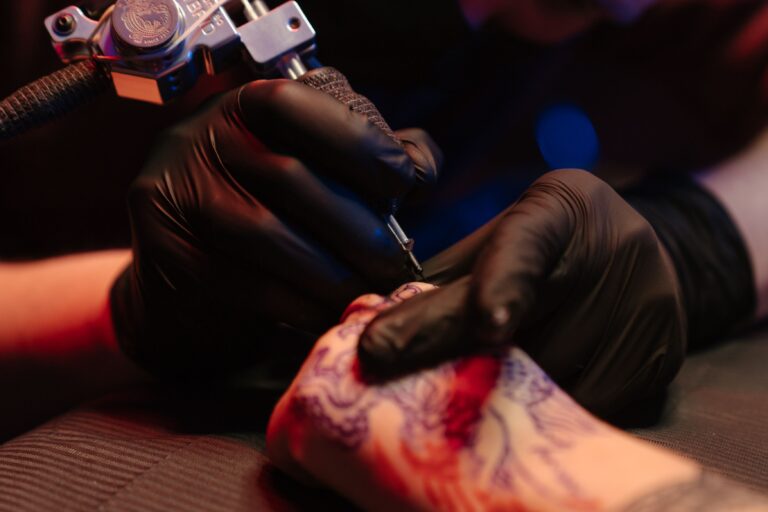

The first tattoo shop I ever walked into had flash sheets pinned on every wall, floor to ceiling, gone a bit yellow at the corners from years of sun and smoke. Swallows, daggers through roses, a black panther that nearly stole my heart away, and right in the middle a pair of dice showing a seven, sitting next to a horseshoe and an ace of spades under a little scroll banner that said “Lady Luck”. I was nineteen and really nervous, and I picked a swallow because it looked kind of friendly. The dice stayed on the wall.
Years later I was sat on the night bus after a show, phone in hand, spinning some slot to kill twenty minutes, and I actually laughed out loud, right there on the top deck! Because there it was again. Horseshoes. Dice. Card aces. A skull with a rose between its teeth. The same flash sheet, more or less, only now it was spinning on five reels with sound effects. That sent me digging, and it turns out the link between tattoo flash and slot reels is way older, and way more tangled, than I ever thought.
Pick It Off the Wall
Flash, if you are new to all this, is simply the ready-drawn designs a shop keeps on display so you can point at one and say “that one, please”. No drawing session, no long consultation, you sit down and it goes on. The golden age of flash was the sailor tattoo, and the name everybody in the trade knows is Norman Collins, better known as Sailor Jerry. He was born in 1911, joined the US Navy at 19, and worked out of shops on and around Hotel Street in Honolulu, where sailors on shore leave walked in with their wages and walked out with fresh ink. He died in 1973. His motifs read like a list of everything a man at sea could possibly want on his side: swallows, anchors, nautical stars, pin-ups, skulls, roses, snakes, knives and dice. His flash has even hung in the Musée du Quai Branly in Paris, which is truly something for drawings that were made to be traced onto sweaty forearms. These days most people know his name from a rum bottle, which tells you a lot about the world.
Nobody got the luck pictures for decoration. A sailor in the 1940s stood a chance to drown, get shot at, or lose a whole month’s wages at cards in one night, so luck was the thing he wanted most, and he wanted it somewhere he could see it.
Every Luck Symbol Has a Back Story
Take the dice. On old flash they nearly always show a seven, the “natural” that wins on the first roll at craps, or else snake eyes as a dark little joke about losing. The horseshoe goes points up so the luck does not pour out, and hang it the wrong way round and, the superstition says, you are asking for trouble. The swallow, the old story goes, was earned for every 5,000 nautical miles at sea, and because swallows always fly home, it was a promise to make it back too. Lucky 13 is the rebel of the bunch: hot-rodders, bikers and rockabilly kids took the unluckiest number going and wore it like a badge, which, if you think about it, is a really punk thing to do.
Then there is the dead man’s hand. Black aces and black eights, the two pair Wild Bill Hickok was said to be holding when Jack McCall shot him in the back of the head in a Deadwood saloon on 2 August 1876. Nobody truly knows what the fifth card was, and nobody wrote the hand down at the time, but that has never stopped anybody from tattooing it. It is luck and death in one picture, which is surely why goths and greasers both love it so much.
And then Lady Luck herself, the pin-up holding a fan of cards or a pair of dice, maybe with a horseshoe glowing behind her head like a halo. Put all of these on one sheet and what you actually have is a slot machine paytable. Isn’t that really weird?
The First Slot Reels Were Basically Flash
Here is the bit that totally knocked my socks off. Around the end of the 1890s, Charles Fey of San Francisco built the Liberty Bell, the machine most people call the grandfather of every slot machine since. It had three reels and only five symbols: horseshoes, diamonds, spades, hearts and a Liberty Bell. Three bells in a row paid ten nickels, so 50 cents, which was decent money back then.
Horseshoes and card suits. That is half of a sailor’s flash sheet, right there on the reels. And the timing is spooky too, because Samuel O’Reilly patented the first electric tattoo machine in December 1891, so the tattoo machine and the slot machine are more or less the same age. A few years later, copycat machines paid out in fruit-flavoured gum to get round the gambling laws, fruit symbols turned up on the reels, and the BAR symbol everybody still knows started life as a picture of a stick of Bell-Fruit Gum. But the bell stayed, the card suits never really went away, and the horseshoe still pops up on reels to this day.
From the Forearm to the Phone
Walk into a shop in Camden or Leeds now and the flash has grown up a bit. Sugar skulls are everywhere, borrowed from the Mexican Day of the Dead, which is held every year on 1 and 2 November, and you will see plenty of grinning skeletons in big fancy hats in the style of the old José Guadalupe Posada prints too. The slot world clocked all of this a long time ago. Look at almost any modern video slot and the low-paying symbols are the A, K, Q, J and 10 from a deck of cards, a straight line back to Fey’s spades and hearts.
Most of my spinning happens on the phone these days, usually on the bus or late at night with the telly on, and the mobile casino at Vegas Mobile Casino has a lobby that reads like a flash sheet if you squint a little. There is a slot actually called Book of Tattoo (and a sequel, Book of Tattoo 2!), there is Day of Dead with the whole sugar skull look, and there is one called Fire and Roses Joker, which sounds like a design you would pick off a parlour wall all by itself. Well then, you are in luck if you are the sort who likes a bit of the dark stuff with your spins! Vegas Mobile Casino keeps the whole lot in your pocket, and you may possibly go from a skull to a horseshoe in about two taps.
Luck You Wear, Luck You Spin
There is one big difference, though, and it is worth saying plainly. A horseshoe on your arm is there forever and you pay for it once. A horseshoe on a reel is random every single time. Modern slots run on a random number generator, so the dice on the screen hold the potential to land any way at all, and no amount of lucky ink changes that, whether you are on Book of Tattoo at Vegas Mobile Casino or feeding a fruit machine down the pub. I have a swallow on my arm and a lucky 13 behind my ear, and trust me, neither of them has ever done one thing for my spins.
So treat it the way you treat a flash piece. Pick something you really like the look of, decide what you are spending before you sit down, and walk away happy when it is done. UK online slots are capped at £5 a spin anyway (£2 if you are 18 to 24), and every licensed site lets you set deposit limits, so definitely use them. Gambling should be way more fun than stressful, and the moment it stops being fun, stop.
Me? I still go back to that first shop now and then. The sheet with the dice and the horseshoe is still on the wall, a bit more yellow now. One day I may possibly get the dead man’s hand done on my forearm. Black aces, black eights, and a little spade for luck. A walk on the wild side, right?