

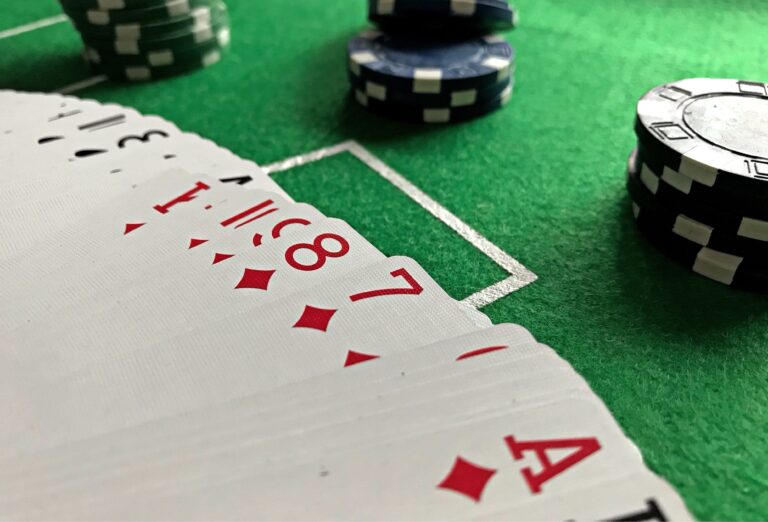

The most useful thing poker gave gambling films was a delay. A roulette wheel or a pair of dice settles a bet in seconds, and a scene built on either often has one decisive moment of suspense and one result. A poker hand spreads a single outcome across several rounds of decisions, and each round gives a director another chance to make the audience wait.
Games Decided in a Single Moment
Older gambling scenes often depend on one throw or one spin. In Casablanca, released in 1942, Rick asks a young Bulgarian refugee if he has played 22 that night, the croupier Emil understands what Rick wants, and the wheel stops on 22. Rick tells the young man to leave his chips where they are, the number comes up again, and Rick tells him to cash in and not come back. The young man needs the money for exit visas, and the rigged wheel is how Rick gives it to him without appearing to. The young man makes no choice of his own beyond placing chips where Rick suggests, and each result arrives the moment the wheel stops.
The scene works through what the audience understands about Rick and the wheel. The roulette itself contributes two spins and two results, with no further betting decisions between them that the character could get wrong.
Guys and Dolls, from 1955, builds a craps game around a single throw. The game has been pushed underground into a city sewer, where Big Jule, a hoodlum from Detroit, refuses to let anyone quit and insists on using his own dice until he wins back a $25,000 loss. After 24 hours of play, Sky Masterson, played by Marlon Brando, offers the other gamblers a single roll of the dice. If he loses, he pays each of them $1,000, and if he wins, they all attend a prayer meeting at the mission that night. He sings “Luck Be a Lady” before the throw, and the song provides much of the suspense, since the roll itself lasts only a moment.
Betting Rounds and Story Structure
Poker supplies what roulette and dice lack, a sequence of choices made under uncertainty. Playing texas hold’em poker means making decisions before the flop, after the flop, on the turn, and on the river, so a hand that reaches the final betting round contains four separate rounds of betting. Each round is a point where a character can act, and each new community card alters what both players can reasonably believe about the other’s hand. In the no-limit form of the game, a player can bet everything at any of those points, and a single decision can put a character’s entire stack at risk.
A scene can open with a modest bet, build through a raise and a re-raise on later cards, and end with a decision to call or fold that the audience has watched being prepared. The result may arrive at the showdown after the final betting round, or earlier if the other players fold, but the tension is spread across everything that comes before it.
A roll of the dice reveals little about the person rolling, while a bet in poker is a statement about what a player holds or wants the table to believe, and an opponent’s response is a judgment of that player.
The Hole-Card Camera
Henry Orenstein, a Holocaust survivor who had already brought the Transformers toys to market, patented a poker table with built-in cameras in 1996 that could show television viewers each player’s hand. He had survived five Nazi concentration and death camps, and he later held more than 100 patents. His design showed a player’s face-down cards to the audience without exposing them to the other players. The technology gained early television exposure in July 1999 on Late Night Poker, a British series on Channel 4 made by the Cardiff company Presentable. Cameras under a transparent table showed each player’s cards in a low-lit studio, while commentators Jesse May and Nic Szeremeta talked through the decisions. Early buy-ins were about £1,500, first prizes ran from £40,000 to £60,000, and the show ran for six series until 2002 before returning from 2008 to 2011.
The camera turned each broadcast hand into a lesson in decisions. With both players’ cards on screen, commentators could explain why a player called, raised, or folded, and viewers could judge every bet against the cards it was made with. This also created dramatic irony, since the audience could know more about the players’ hands than the players knew about each other. Orenstein died in 2021 at the age of 98, and the technology he helped develop became standard on televised poker broadcasts.
Films After the Poker Boom
Lucky You opened on May 4, 2007, on a reported budget of $55 million and earned about $6.5 million worldwide, roughly 12% of its production cost. Directed by Curtis Hanson, it follows Huck Cheever, a Las Vegas player played by Eric Bana, through a major 2003 tournament in which he faces his estranged father, played by Robert Duvall, and it filled its tables with real professionals such as Doyle Brunson and Daniel Negreanu. Filming began on March 28, 2005, but the film remained unreleased for about two years following delays and reported difficulties with test screenings.
21, released in 2008 and based on Ben Mezrich’s 2003 book about the MIT blackjack team, opened at the top of the North American box office with $23.7 million and went on to earn about $159.8 million worldwide on a $35 million budget. Card counting produces an advantage only across many hands, so the film’s casino sequences involve long stretches of waiting for the count to turn favorable. Although blackjack differs from poker, this extended uncertainty creates a similar pattern of tension rather than relying on a single spin or throw.
In Uncut Gems, from 2019, Adam Sandler’s jeweler Howard Ratner places a six-way parlay on Kevin Garnett’s performance in a single playoff game, and the bet plays out over the full game with Howard watching every possession. He raises the stake by pawning Garnett’s 2008 championship ring for $21,000, and the money and the ring are both at risk until the final buzzer. The Safdie brothers surround that wait with loud, crowded sound and restless camera work, and the bet functions much like a poker hand with many streets, each one a fresh chance for the result to turn. The comparison is one of suspense and pacing, rather than the games themselves.
Delay and Tension in Gambling Films
In a gambling film, tension often grows from the time between a decision and its result, extended by every further decision a character still has to make. The stakes, uncertainty, and audience’s knowledge of the characters also shape that suspense. A spin of a wheel can produce a powerful moment of it, while a single hand of poker can sustain it through several rounds of betting. That sequence of choices gives filmmakers more opportunities to reveal character, change expectations, and keep the audience waiting for the outcome.